
ICS International Chronostratigraphic Chart receives update 2026/06
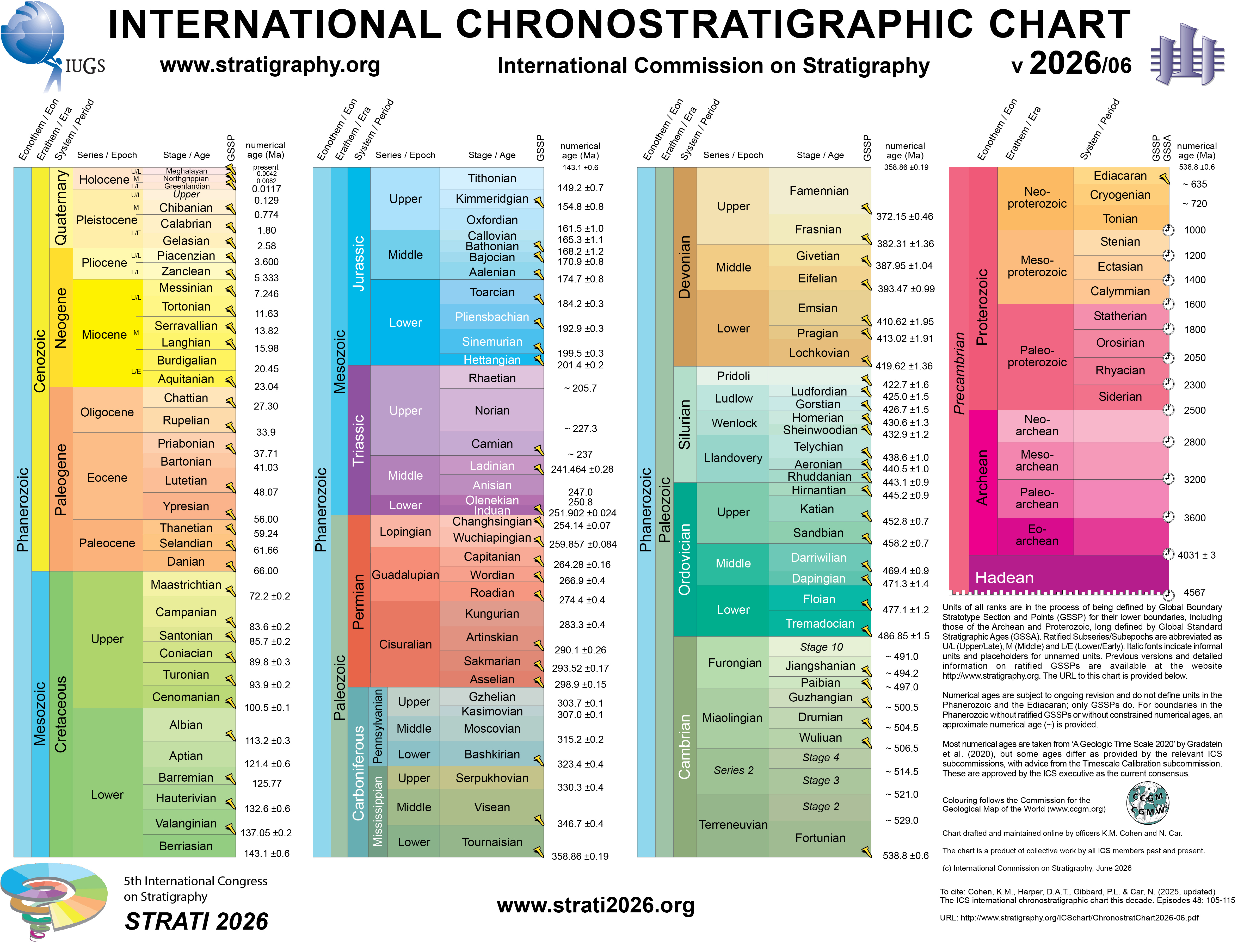
The International Chronostratigraphic Chart (as distributed at www.stratigraphy.org/chart) from time to time receives updates (Cohen et al., 2025), when definition status of geological time units changes and/or when insight in numeric age of unit boundaries is improved.
This June (2026/06), the ICS released an updated version of the Chart. For three stage units – two in the Triassic and one in the Permian, numeric ages and their precision have been improved. Such age updating decisions are taken by Subcommissions per System, in consultancy with the subcommission on Timescale Calibration and the ICS executive.
- The base Anisian Stage (Triassic) has a new numeric age of 247.0 Ma (was: 246.7 Ma)
- The base Olenekian Stage (Triassic) has a new numeric age of 250.8 Ma (was: 249.9 Ma)
- The base Wuchiapingian Stage (Permian) has a new numeric age of 259.857 ± 0.084 Ma (was: 259.51 ± 0.21 Ma)
The updates to the Triassic stages follow age-calibrations published in Leu et al. (2025) and Dai et al. (2025). The numeric ages are single decimal rounded results of the calibration-derived ages in these papers: 247.05 resp. 250.867 Ma from Leu et al. (2025) and 246.979 resp. 250.626 Ma from Dai et al. (2025). The update to the Permian Wuchiapingian - also the Guadalupian-Lopingian boundary, follows Wu et al. (2026) and took over the numeric precision in that paper.
In parallel also the effort to define stages with global boundary stratotype sections and points (GSSPs) continues. When GSSP proposals are approved and ratified, this will result in the next chart release, which is currently anticipated for 2026/12.
References
Cohen, K., Harper, D., Gibbard, P., & Car, N. (2025). The ICS international chronostratigraphic chart this decade. Episodes 48(1), 105-115. DOI: 10.18814/epiiugs/2025/025001
Dai, X., Ovtcharova, M., Davies, J. H., Song, H., Liu, X., Yuan, Z., Cao, Y., Bai, R., Chu, D., Cal Corso, J., Brayard, A., Jiang, S., Miao, L. & Song, H. (2025). Geochronology of the Early Triassic based on coupled Bayesian zircon eruption age and Bayesian age–depth models. Proceedings of the National Academy of Sciences, 122(44), e2509247122. DOI: 10.1073/pnas.2509247122
Leu, M., Paul, A. N., Bucher, H., Widmann, P., Luz, Z., Vennemann, T., and Schaltegger, U., 2025. The Early Triassic time scale: New constraints from the Nanpanjiang Basin in South China and a review of geochronological, biostratigraphical and carbon isotope data. Earth-Science Reviews, 105157. DOI: 10.1016/j.earscirev.2025.105157
Wu, Q., Hou, Z. S., Ramezani, J., Yuan, D. X., Zhang, H., Wang, W. Q., … & Shen, S. Z. (2026). Why the end-Guadalupian biotic crisis differs from mass extinctions: Insights from high-precision geochronology and carbon cycle modeling. Earth and Planetary Science Letters, 679, 119898. DOI: 10.1016/j.epsl.2026.119898